1. 方法原理Principle
双电极电压钳(Two-Electrode Voltage Clamp, TEVC)是研究爪蟾卵母细胞异源表达蛋白的经典电生理方法。两根尖端直径约 1 μm 的玻璃微电极同时刺入同一卵母细胞:电压电极持续监测跨膜电位(Vm);电流电极由钳位放大器实时注入补偿电流,使 Vm 精确维持在设定的钳制电位(Vcmd)。所记录的补偿电流即等于流过目标离子通道或转运体的宏观电流(Im),可直接反映蛋白质功能。Two-Electrode Voltage Clamp (TEVC) is the standard electrophysiology method for characterising proteins heterologously expressed in Xenopus oocytes. Two glass microelectrodes (~1 µm tip) are impaled into the same oocyte: the voltage electrode continuously monitors membrane potential (Vm); the current electrode injects compensating current via a clamp amplifier to maintain Vm precisely at the command potential (Vcmd). The injected current equals the macroscopic transmembrane current (Im) through the target channel or transporter.
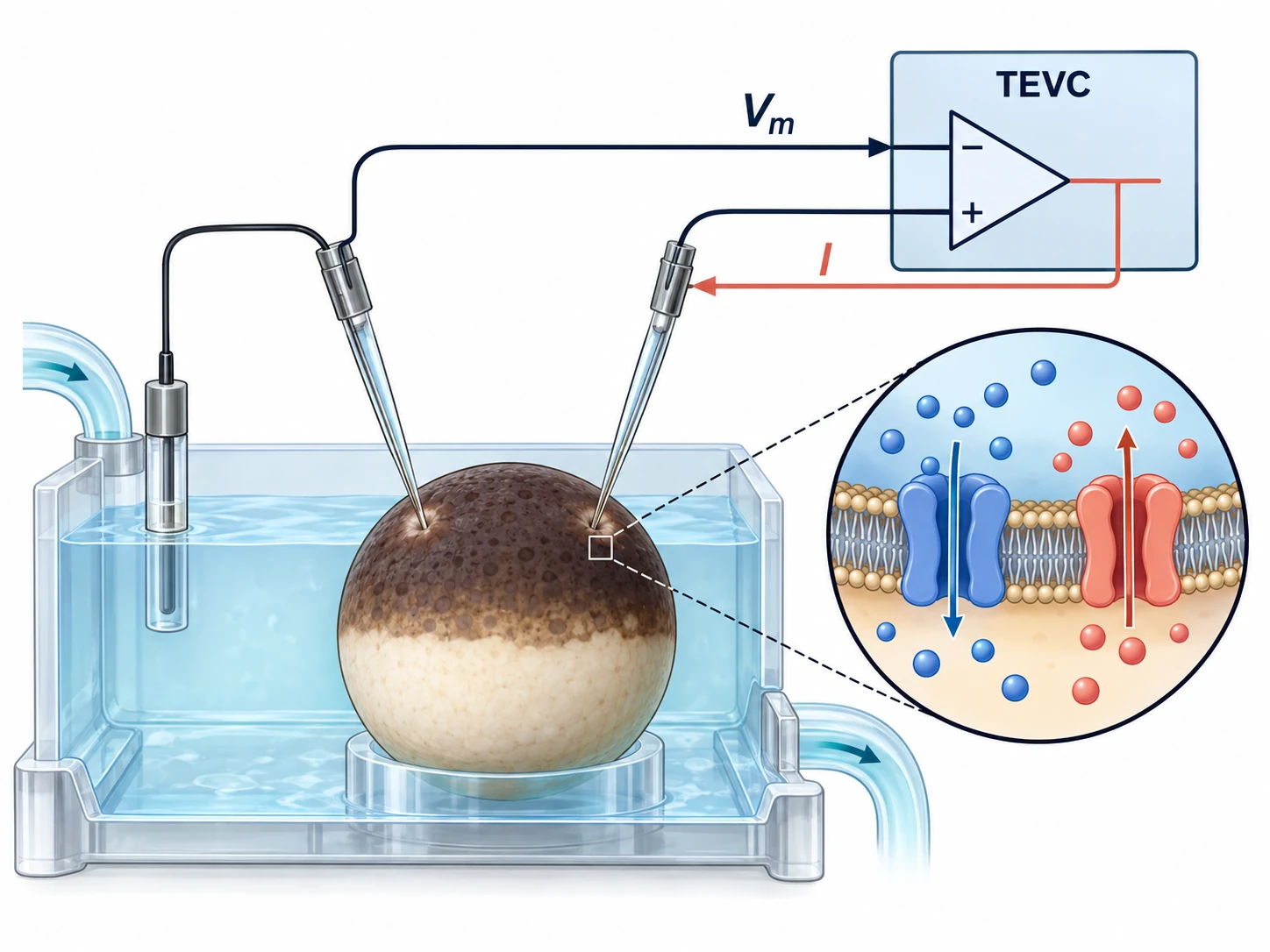
与膜片钳相比,TEVC 无需形成高阻封接,操作简便;爪蟾卵母细胞直径约 1.2 mm,表面积大(信号电流可达 μA 级),适合研究电流密度较低的通道、转运体或受体。Unlike patch clamp, TEVC requires no high-resistance seal. The large oocyte surface (~1.2 mm diameter) generates macroscopic currents in the µA range, making TEVC ideal for low-density channels, transporters and receptors.
2. 实验设备Equipment
| 设备Item | 规格 / 型号(参考)Spec / model (ref.) |
|---|---|
| 电压钳放大器Voltage-clamp amplifier | Warner OC-725C 或 Dagan TEV-200A 或 Axon GeneClamp 500B |
| 微操纵器(×2)Micromanipulators (×2) | Narishige MHW-3 或同类三维液压式 |
| 防振台Anti-vibration table | 气浮或主动隔振Pneumatic or active isolation |
| 法拉第屏蔽笼Faraday cage | 接地铜网或铝制屏蔽箱Copper mesh or Al shield box |
| 倒置 / 正置显微镜Microscope | 4–10× 物镜,同轴照明4–10× objective, coaxial illumination |
| 微电极拉制仪Micropipette puller | Sutter P-97 或 Narishige PC-10 |
| 灌流系统Perfusion system | 重力驱动或蠕动泵,流速 1–2 mL/minGravity or peristaltic, 1–2 mL/min |
| 数据采集卡Data acquisition | Digidata 1550B + pCLAMP 11 或同类 |
| 接地 Ag/AgCl 参考电极Ground Ag/AgCl reference | 浸浴式,3M KCl 琼脂盐桥Bath-type, 3M KCl agar bridge |
3. 微电极制备Electrode preparation
- 玻璃管:硼硅酸盐薄壁毛细管(外径 1.5 mm,内径 1.1 mm),使用前 180 ℃ 烘干 4 h 去除内壁水分。Glass: borosilicate thin-wall capillaries (1.5/1.1 mm OD/ID); bake at 180 ℃ for 4 h to remove moisture.
- 拉制参数:目标阻抗 0.5–2 MΩ(3M KCl 填充后于外液中测定);阻抗过高(>5 MΩ)噪声大,过低(<0.3 MΩ)易损伤卵母细胞。Pull parameters: target resistance 0.5–2 MΩ (measured in external solution with 3M KCl fill); >5 MΩ is noisy, <0.3 MΩ damages the oocyte.
- 填充:两根电极(电压电极与电流电极)均后端灌入 3M KCl,轻弹去除气泡后接入 Ag/AgCl 丝。TEVC 电极不透析细胞内液,无需配制膜片钳式的胞内液。部分实验室使用 1–2M KAc 替代,以减少 Cl⁻ 沿电极尖端漏入浴槽。Filling: back-fill both electrodes (voltage and current) with 3M KCl; flick out bubbles; insert Ag/AgCl wire. TEVC electrodes do not dialyse the cell — no patch-clamp-style internal solution is needed. Some labs use 1–2M KAc instead to minimise Cl⁻ leakage at the electrode tip.
- 液接电位:入浴前在外液中调零;每次更换批次电极或外液成分须重新调零。Liquid junction potential: zero offset in external solution before impalement; re-zero when changing electrode batch or external solution composition.
4. 实验溶液Solutions
电极充填液(两根电极通用)Electrode fill (both electrodes)
| 电极Electrode | 充填液Fill | 说明Notes |
|---|---|---|
| 电压电极Voltage electrode | 3M KCl | 标准,液接电位小Standard; minimal junction potential |
| 电流电极Current electrode | 3M KCl | 与电压电极相同;可用 1–2M KAc 替代以减少尖端 Cl⁻ 渗漏Same as voltage electrode; 1–2M KAc may substitute to reduce tip Cl⁻ leakage |
TEVC 两根电极均为"穿刺式"——仅穿透卵母细胞膜建立电学通路,不透析细胞内液,因此无需配制膜片钳式的胞内液(含 Cs⁺、TEA、ATP/GTP 等)。3M KCl 液接电位约 −4 mV(与 ND96 接触),入浴调零后可忽略。TEVC electrodes are "sharp" — they penetrate the membrane to make electrical contact only and do not dialyse the cytoplasm. No patch-clamp-style internal solution (with Cs⁺, TEA, ATP/GTP) is needed. The liquid junction potential of 3M KCl vs. ND96 is approximately −4 mV and is nulled before impalement.
浴槽灌流液:标准 ND96Bath solution: standard ND96
| 成分Component | 终浓度Conc. |
|---|---|
| NaCl | 96 mM |
| KCl | 2 mM |
| CaCl₂ | 1.8 mM |
| MgCl₂ | 1 mM |
| HEPES | 5 mM |
NaOH 调 pH 至 7.4±0.05;渗透压约 200 mOsm/kg;4 ℃ 保存 ≤7 天。适用于大多数离子通道、配体门控受体与转运蛋白的记录。Adjust pH to 7.4±0.05 with NaOH; osmolarity ~200 mOsm/kg; store ≤7 days at 4 ℃. Suitable for most ion channels, ligand-gated receptors and transporter recordings.
浴槽灌流液:无 Ca²⁺ ND96(用于抑制 ICl(Ca))Bath solution: Ca²⁺-free ND96 (to suppress endogenous ICl(Ca))
| 成分Component | 终浓度Conc. |
|---|---|
| NaCl | 96 mM |
| KCl | 2 mM |
| BaCl₂ (替代 CaCl₂)(replaces CaCl₂) | 1.8 mM |
| MgCl₂ | 1 mM |
| HEPES | 5 mM |
Ba²⁺ 不激活爪蟾卵母细胞内源性 Ca²⁺ 激活的 Cl⁻ 电流(ICl(Ca));适用于研究 Ca²⁺ 通透通道或 Ca²⁺ 转运体时,以避免内源性 ICl(Ca) 污染信号。pH 7.4;4 ℃ 保存 ≤7 天;Ba²⁺ 本身可轻度阻断某些 K⁺ 通道,注意对照。Ba²⁺ does not activate the endogenous Ca²⁺-activated Cl⁻ current (ICl(Ca)); use when studying Ca²⁺-permeable channels or Ca²⁺ transporters to prevent endogenous ICl(Ca) contamination. pH 7.4; store ≤7 days at 4 ℃. Note that Ba²⁺ can mildly block some K⁺ channels — include appropriate controls.
5. 卵母细胞准备Oocyte preparation
- 选用注射 cRNA 后 16–48 h 的 V–VI 期卵母细胞;形态:动物极深棕、植物极乳白、赤道界清晰、表面光滑无损。Use stage V–VI oocytes 16–48 h after cRNA injection; morphology: dark animal pole, pale vegetal pole, clear equatorial border, smooth surface.
- 将单个卵母细胞转入记录槽(外液灌流中),植物极朝上放置有助于减少内源性电流干扰。Transfer a single oocyte to the recording chamber under external solution perfusion; orient with vegetal pole up to minimise endogenous current contamination.
- 必须设阴性对照:非注射卵母细胞(uninjected)与注射水的卵母细胞(water-injected)在相同条件下同步记录,以扣除内源性背景电流。Always include negative controls: uninjected and water-injected oocytes recorded under identical conditions to subtract endogenous background currents.
6. 记录操作步骤Recording procedure
- 入浴调零:将两根充填好的电极浸入外液,调零液接电位(offset);记录此时电极阻抗(目标 0.5–2 MΩ)。Bath offset: immerse both filled electrodes in external solution; zero liquid junction potential; record electrode resistance (target 0.5–2 MΩ).
- 电压电极刺入:在显微镜下将电压电极尖端对准卵母细胞动物极赤道附近,轻柔推进直至穿透卵膜(静息电位立即跳变至 −40 至 −70 mV 为穿刺成功标志)。Voltage electrode impalement: position tip near the equatorial zone of the animal pole; advance gently until membrane penetration — a sudden jump to −40 to −70 mV indicates success.
- 电流电极刺入:在距电压电极 50–150 μm 处刺入第二根电极(电流电极),观察 Vm 是否维持稳定;若 Vm 剧烈波动则重新定位。Current electrode impalement: impale 50–150 µm from the voltage electrode; check Vm stability — large oscillations indicate poor impalement and require repositioning.
- 建立钳制:启动钳位模式,将 Vcmd 设为保持电位(通常 −80 mV);检查钳制质量——电流应在切换后 <1 ms 达到稳定,无持续振荡。Engage clamp: switch to voltage-clamp mode with holding potential −80 mV; verify clamp quality — current should settle in <1 ms with no oscillation.
- 稳定期:在保持电位下等待 2–5 min,待漏电流(leak)稳定后开始施加刺激方案。Equilibration: wait 2–5 min at holding potential until leak current stabilises before applying stimulus protocols.
- 实验与给药:通过灌流系统给予激动剂、拮抗剂或改变离子成分;每次给药前后均在保持电位下记录基线。Drug application: apply agonists, antagonists or ion substitutions via perfusion; record baseline at holding potential before and after each application.
7. 常用电压方案Voltage protocols
| 方案Protocol | 参数Parameters | 用途Application |
|---|---|---|
| 阶跃方案Step protocol | −120 至 +60 mV,20 mV 步进,200–500 ms−120 to +60 mV, 20 mV steps, 200–500 ms | I–V 曲线,激活 / 失活动力学I–V curve, activation/inactivation kinetics |
| 斜坡方案Ramp protocol | −120 → +60 mV,1–2 V/s−120 → +60 mV, 1–2 V/s | 快速 I–V 关系,反转电位定量Rapid I–V, reversal potential |
| 保持电位给药Holding + drug | 固定 −80 mV,灌流给药Fixed −80 mV, drug perfusion | 配体门控通道、转运体电流Ligand-gated channels, transporter currents |
| 尾电流方案Tail-current protocol | 激活脉冲 + 复极化尾步Activating pulse + repolarising tail step | 反转电位、Ca²⁺ / K⁺ 选择性Reversal potential, Ca²⁺/K⁺ selectivity |
8. 常见问题排查Troubleshooting
| 问题Problem | 可能原因Likely cause | 解决方法Solution |
|---|---|---|
| Vm 无法稳定(>−40 mV)Unstable Vm (>−40 mV) | 卵母细胞不健康或穿刺位置不当Unhealthy oocyte or poor impalement site | 更换卵母细胞;重新刺入电压电极Replace oocyte; re-impale voltage electrode |
| 钳制建立后持续振荡Oscillation after clamp engage | 增益过高或电极电阻不匹配Gain too high or electrode resistance mismatch | 降低增益旋钮;重拉配对电极Reduce gain; pull matched-resistance pair |
| 基线电流漂移Baseline current drift | 温度波动 / 灌流气泡 / Ag/AgCl 老化Temperature fluctuation, perfusion bubbles, aged Ag/AgCl | 恒温水浴;排除气泡;重新氯化参考电极Temperature control; degas solution; re-chloride reference electrode |
| 信噪比差(>50 pA rms)Poor SNR (>50 pA rms) | 接地不良 / 外界电磁干扰Poor ground / EMI | 检查单点接地;关闭屏蔽笼内荧光灯;远离电机Check single-point ground; turn off internal fluorescent lights; move away from motors |
| 表达电流极小或缺失Tiny or absent expression current | cRNA 降解 / 注射量不足 / 孵育时间过短cRNA degraded, insufficient injection, short incubation | 检查 cRNA 完整性(凝胶);增加注射量;延长孵育至 48 hCheck cRNA integrity (gel); increase dose; extend incubation to 48 h |
质控标准:静息膜电位 ≤−40 mV,漏电流 ≤100 nA(保持 −80 mV),串联阻抗 <0.5 MΩ。不满足上述任一条件的卵母细胞须弃用。每批次记录结束后须以 uninjected 对照组确认无内源性电流污染。QC criteria: resting Vm ≤−40 mV, leak current ≤100 nA (at −80 mV holding), series resistance <0.5 MΩ. Discard oocytes failing any criterion. Confirm absence of endogenous current contamination using uninjected controls at the end of each session.
参考文献References
- Goldin AL (1992) Maintenance of Xenopus laevis and oocyte injection. Methods Enzymol 207:266–279.
- Sigel E (1990) Use of Xenopus oocytes for the functional expression of plasma membrane proteins. J Membr Biol 117(3):201–221.
- Stühmer W (1992) Electrophysiological recording from Xenopus oocytes. Methods Enzymol 207:319–339.