以爪蟾卵母细胞为异源表达系统,通过 TEVC 技术精准测定离子通道、受体与转运蛋白的电流特性、电压依赖性和药理学响应,是国际公认的离子通道研究金标准方法。Using the Xenopus oocyte heterologous expression system, TEVC precisely measures currents, voltage dependence and pharmacological responses of ion channels, receptors and transporters — the internationally recognised gold-standard for ion channel research.
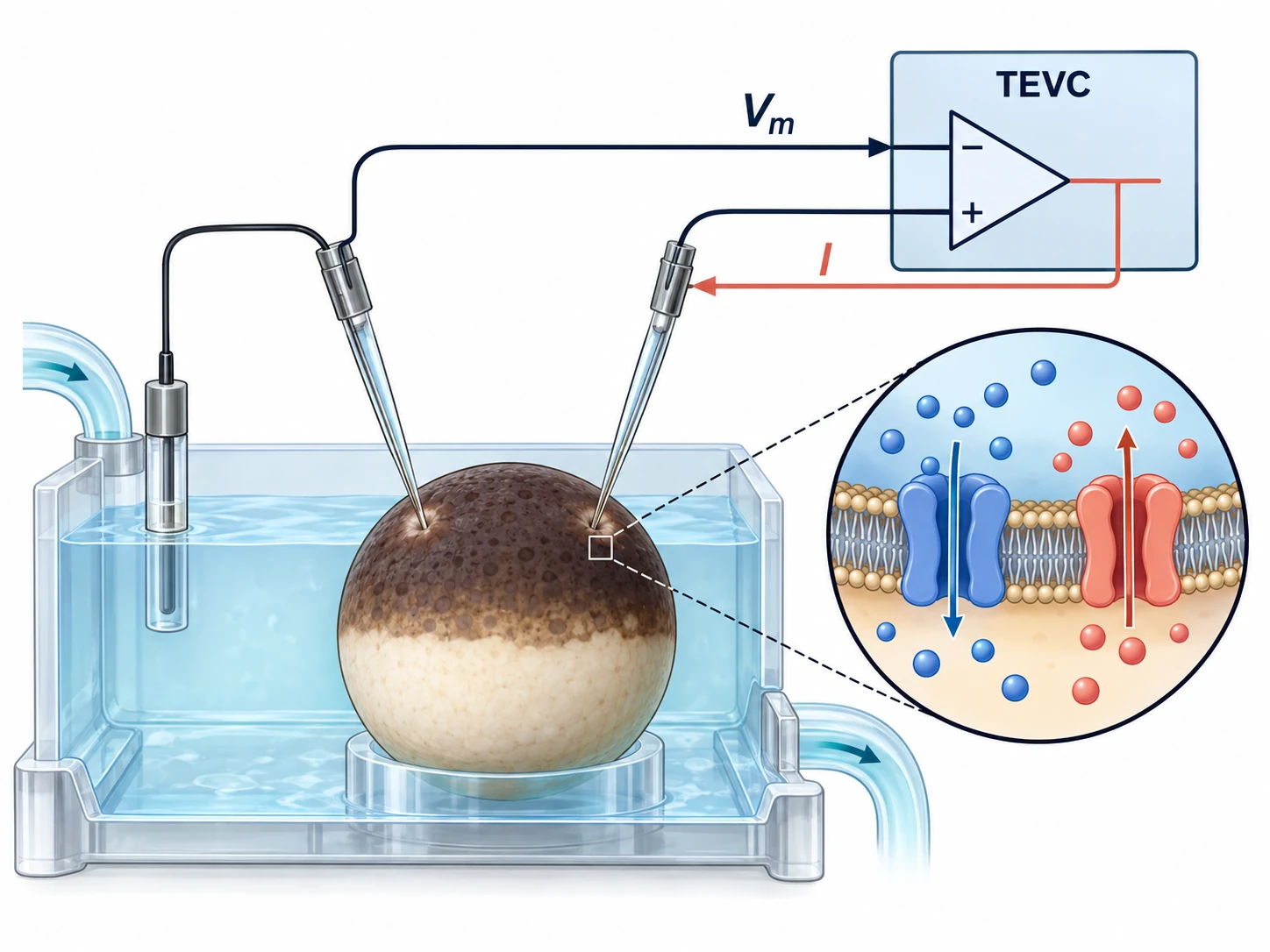
双电极电压钳(Two-Electrode Voltage Clamp,TEVC)通过两个独立的玻璃微电极同步工作:电压电极实时监测膜电位,电流电极向细胞注入补偿电流使膜电位钳制在目标值。在精准的电压控制下,跨膜离子电流得以精确测量,信噪比远优于哺乳动物细胞系统。TEVC uses two independent glass microelectrodes: a voltage electrode monitors membrane potential in real time, while a current electrode injects compensatory current to clamp the membrane at the target voltage. Under precise voltage control, transmembrane ionic currents are measured with signal-to-noise ratios far superior to mammalian cell systems.
爪蟾卵母细胞(直径 1–1.3 mm)体积大、内源通道背景低,是 TEVC 研究的理想宿主细胞,已被用于表达来自植物、动物、微生物的数千种离子通道与转运蛋白。Xenopus oocytes (diameter 1–1.3 mm) are large, with low endogenous channel background — the ideal TEVC host cell, used to express thousands of channels and transporters from plants, animals and microorganisms.
| 参数Parameter | 规格Specification |
|---|---|
| 电极类型Electrode type | 硼硅酸玻璃微电极,充填 3 M KCl,阻抗 0.5–2 MΩBorosilicate glass microelectrodes, filled with 3 M KCl, resistance 0.5–2 MΩ |
| 标准浴槽液Standard bath | ND96(NaCl 96 mM / KCl 2 mM / CaCl₂ 1.8 mM / MgCl₂ 1 mM / HEPES 5 mM,pH 7.4) |
| 电压钳制范围Voltage clamp range | −150 mV ~ +60 mV(可定制) |
| 采样频率Sampling rate | 1–10 kHz(按通道动力学选择) |
| 客户提供Client provides | 基因序列 / 质粒 / cRNA;待测化合物(如需)Gene sequence / plasmid / cRNA; test compounds (if required) |
| 交付物Deliverables | 完整技术报告 + 原始数据 + 分析图表(I-V / G-V / 剂量 – 效应曲线)Full technical report + raw data + analysis figures (I-V / G-V / dose-response) |
点击 DOI 链接可在新窗口查看原文。完整名单见 客户 SCI 论文精选。Click the DOI link to view each paper. Full list: client SCI papers.
提供目的基因与实验方案,我们完成全流程 TEVC 检测并出具专业报告。Submit your gene and experimental goals — we handle the full TEVC workflow and deliver a professional report.