综述 · Review · 研究进展Research
非洲爪蟾(Xenopus laevis)自 20 世纪 30 年代进入实验室以来,已成为生命科学多个领域不可替代的模式动物。其独特的生物学特性——体外受精、大型卵母细胞、透明胚胎、卵提取物易于制备——使其在细胞生物学、发育生物学、神经科学、毒理学和药物研发中均有广泛应用。Since entering the laboratory in the 1930s, Xenopus laevis has become indispensable across multiple fields of life science. Its unique properties — external fertilization, large oocytes, transparent embryos, and easily prepared egg extracts — make it broadly applicable in cell biology, developmental biology, neuroscience, toxicology and drug discovery.
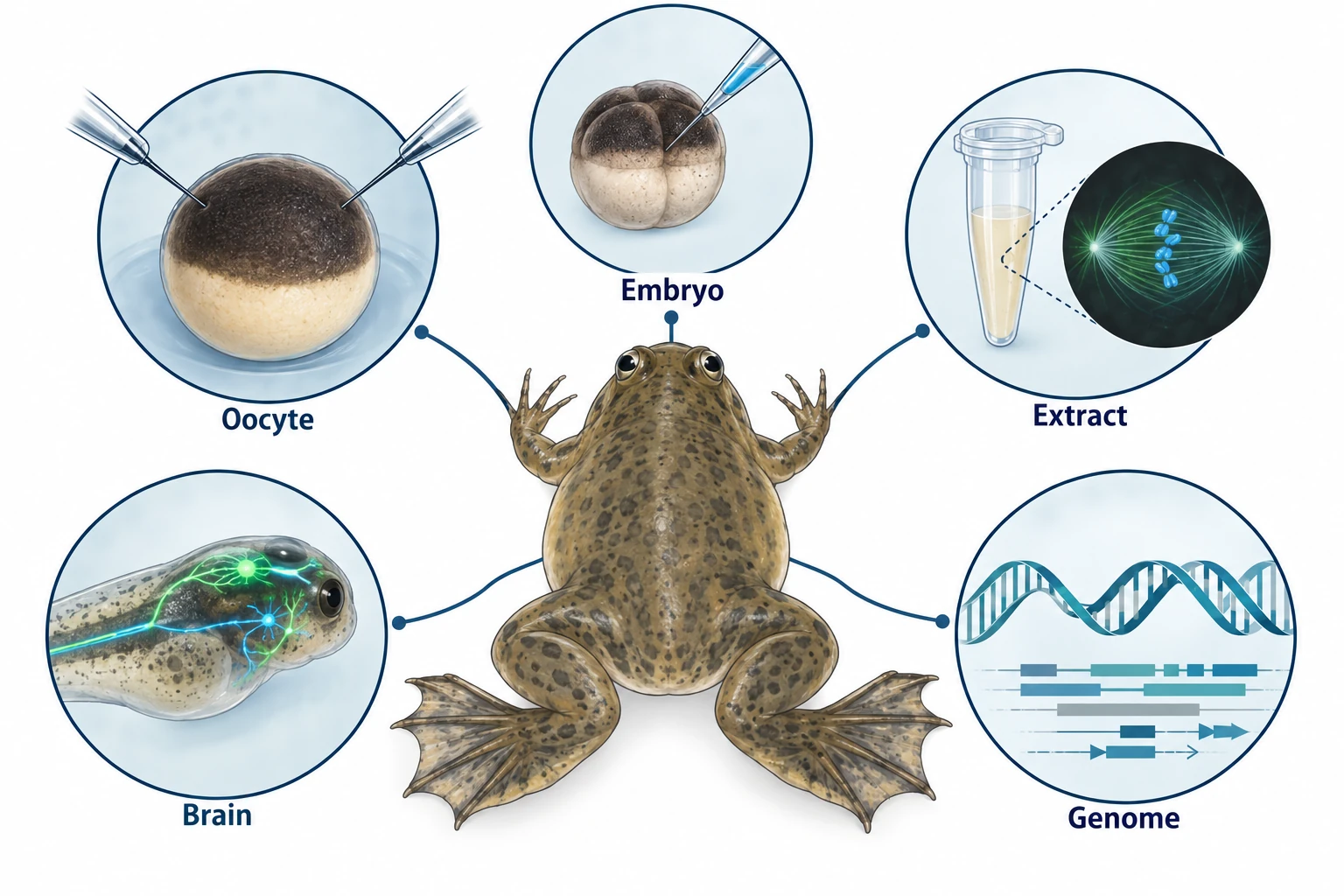
这是爪蟾最经典也最广泛的应用之一。Dumont V–VI 期卵母细胞直径约 1–1.3 mm,富含内源性翻译机器,向其细胞质注射外源 cRNA(50–70 nL,1–5 ng/nL)后,在 18–22℃ 孵育 1–3 天即可高效表达目的蛋白。This is the most classic and widely used Xenopus application. Stage V–VI oocytes (diameter ~1–1.3 mm) are loaded with endogenous translational machinery. Injecting 50–70 nL of exogenous cRNA (1–5 ng/nL) into the cytoplasm followed by 1–3 days incubation at 18–22 °C yields robust protein expression.
该系统适用于:离子通道(Na⁺、K⁺、Ca²⁺、Cl⁻ 通道)、G蛋白偶联受体(GPCR)、转运蛋白、核受体和酶的功能研究;可与双电极电压钳(TEVC)或膜片钳结合,进行高通量离子通道药物筛选。This system supports functional studies of: ion channels (Na⁺, K⁺, Ca²⁺, Cl⁻), GPCRs, transporters, nuclear receptors and enzymes. Combined with TEVC or patch-clamp electrophysiology, it enables high-throughput ion channel drug screening.
手术取卵或自然排卵后,经胶原酶处理(1 mg/mL,22℃,90–120 min)分散卵丘细胞,筛选均匀、不透明动物极的 V–VI 期卵母细胞;去核操作可移除生发泡,用于核移植或无核卵提取物制备。After surgical ovariectomy, collagenase treatment (1 mg/mL, 22 °C, 90–120 min) disperses follicle cells; stage V–VI oocytes with uniform, opaque animal poles are selected. Enucleation (germinal vesicle removal) enables nuclear transplantation or anucleate egg extract preparation.
爪蟾卵母细胞的大体积使显微注射在常规解剖显微镜下即可完成,无需高倍显微操作系统。注射物可为:cRNA、DNA 质粒、反义 Morpholino、蛋白质、荧光探针或药物分子。胚胎期注射可靶向单个卵裂球,追踪细胞谱系或实现组织特异性基因操控。The large oocyte size allows microinjection under a standard dissection microscope without high-power manipulation systems. Injectants include: cRNA, DNA plasmids, antisense Morpholinos, proteins, fluorescent probes or drug molecules. Injection into specific blastomeres enables cell-lineage tracing or tissue-specific gene manipulation.
爪蟾是核移植(克隆)技术的奠基模型(Gurdon 1962)。将体细胞核移植到去核卵母细胞后,细胞质因子重编程细胞核,最终形成新个体。这一技术为细胞重编程机制研究(包括 iPSC 的理论基础)以及物种保育提供了关键方法。Xenopus is the founding model for nuclear transplantation/cloning (Gurdon 1962). Cytoplasmic factors in the enucleated egg reprogram a transplanted somatic nucleus, ultimately generating a new individual. This technique provides key approaches for studying reprogramming mechanisms (foundational to iPSC biology) and species conservation.
爪蟾卵提取物(egg extract)是研究 DNA 复制、核膜组装、染色体凝聚和有丝分裂纺锤体的经典体外系统。大量 Cyclin/CDK 调控机制、DNA 损伤修复检查点以及核孔复合物组装的核心知识均来自爪蟾卵提取物体系。Xenopus egg extracts are a classic in-vitro system for studying DNA replication, nuclear envelope assembly, chromosome condensation and mitotic spindle formation. Much of what is known about Cyclin/CDK regulation, DNA damage checkpoints and nuclear pore complex assembly derives from this system.
利用卵提取物体系,可对小分子抑制剂进行高通量筛选,评估其对 DNA 复制启动、细胞周期进程或核结构装配的影响,是早期药物靶点验证的有效工具。Egg extract systems support high-throughput screening of small-molecule inhibitors for their effects on DNA replication initiation, cell-cycle progression or nuclear assembly — an effective tool for early-stage drug target validation.
Xenbase(xenbase.org)是爪蟾专属的模式动物数据库,整合了基因组序列、基因表达图谱(原位杂交、RNA-seq)、抗体资源、突变体表型及文献检索功能。它是爪蟾研究社区的核心信息枢纽,由 NIH 长期资助。Xenbase is the dedicated Xenopus model organism database, integrating genome sequences, gene expression atlases (ISH, RNA-seq), antibody resources, mutant phenotypes and literature search. Funded by NIH, it is the central information hub for the Xenopus community.
爪蟾蝌蚪具有较强的尾部再生能力,成体爪蟾的皮肤也具有一定的抗菌肽分泌能力(如 Magainin)。这些特性使爪蟾成为研究脊椎动物再生机制、皮肤免疫及天然抗菌产物开发的重要模型。Xenopus tadpoles possess robust tail regeneration capacity, while adult skin secretes antimicrobial peptides (e.g., Magainins). These properties make Xenopus a valuable model for studying vertebrate regeneration mechanisms, skin immunity and natural antimicrobial product development.
了解更多:TEVC 操作规程 · 卵母细胞 cRNA 微注射 · 中心技术服务See also: TEVC protocol · oocyte cRNA injection · Center services